
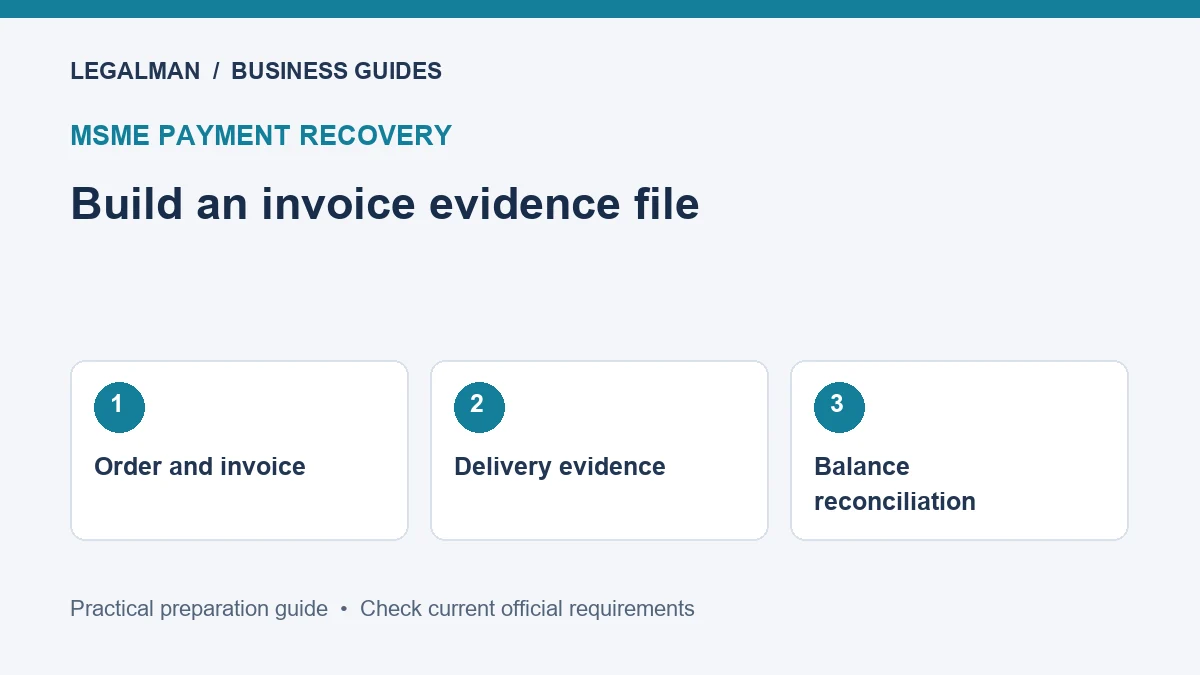
MSME payment recovery documents are most useful when they explain the transaction clearly. A large folder of invoices can still leave unanswered questions about the buyer, delivery, acceptance or outstanding balance. Build an invoice-level evidence file before selecting a recovery route or making claims about the amount recoverable.
Identify the parties and transaction
Record the supplier’s legal name, registration information and the buyer’s correct legal identity. Keep the contract, purchase order or other available record showing what was agreed and who placed the order.
Eligibility for the delayed-payment framework should be checked for the particular supplier and transaction. Do not assume that every enterprise described as an MSME has the same remedy. The Ministry’s guidance specifically discusses micro and small enterprises.
Connect each invoice with performance
For every unpaid invoice, link the relevant order, supply or service record and any available acknowledgement. Where delivery or completion is disputed, identify the issue instead of describing the entire amount as admitted.
Maintain original emails and attachments. An exported conversation should preserve its context and dates. A spreadsheet summary is useful for navigation, but it should point back to the source record rather than replace it.
Reconcile the balance
Prepare a ledger showing invoice value, payments, credit notes, deductions and the amount claimed as outstanding. Separate disputed deductions from undisputed payments so a reviewer can understand the disagreement.
If interest is being considered, keep the principal calculation separate. The applicable legal basis and transaction dates need review before quoting a recoverable interest figure or deadline.
Prepare a clear handover pack
Write a one-page chronology with the order date, performance dates, invoices, reminders and buyer responses. Add a list of missing records. This makes the first review more productive than forwarding an unstructured message history.
Confirm the current official filing route and forum before action. Organising evidence does not establish limitation, jurisdiction, eligibility or the merits of a claim. A case-specific assessment is necessary where these questions arise.
Example: an invoice paid in two parts
An invoice of ₹1,00,000 with two recorded payments of ₹20,000 has an unreconciled balance of ₹60,000 before any credit note or disputed deduction is considered. Show both payments against the invoice. If the buyer also claims a deduction, list it separately so that the reviewer can see the arithmetic and the unresolved issue.
Frequently asked questions
Are invoices alone always sufficient?
Not necessarily. The reviewer may need evidence of the agreement, performance, acceptance, payments and any dispute.
Can medium enterprises assume the same delayed-payment route applies?
No. Check the applicable eligibility; the Ministry’s cited framework describes micro and small enterprises.
Does a complete file guarantee recovery?
No. Evidence preparation improves clarity but does not guarantee a decision, settlement or payment.
Plan your next step
For a review of your own records and the assistance needed, explore our MSME payment recovery support. Share the relevant records so that missing information can be identified before work begins.
Official reference: Government guidance and current application information. This article is a practical preparation guide, not an exhaustive statutory checklist. Requirements depend on the project, transaction and rules applicable when action is taken.