
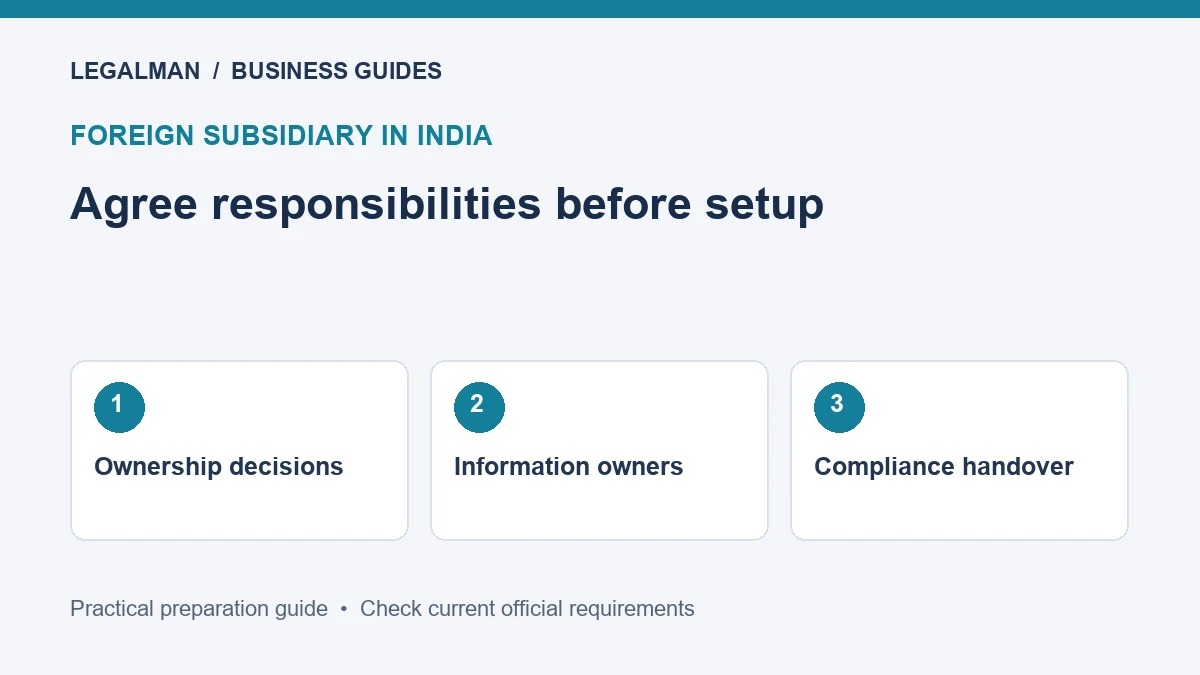
Planning a foreign subsidiary company in India involves more than collecting incorporation documents. The parent company and the proposed Indian team need to agree who will make decisions, supply information and manage the work after setup. A short responsibility plan can prevent delays caused by unanswered commercial questions.
Clarify the proposed activity and ownership
Describe what the Indian company will do, who its customers will be and how it will be funded. Record the proposed ownership structure and identify questions that require a sector-specific foreign-investment review.
Do not assume that one structure suits every activity or investor. Before committing to a route, check the applicable investment conditions and obtain advice on issues specific to the proposed business.
Allocate decision and information roles
Name a parent-company contact for approvals and an Indian contact for local coordination. Decide who can confirm the proposed name, shareholding and commercial activity, and who will arrange documents from overseas.
Use a tracker showing the item, responsible person, dependency and status. Avoid circulating competing versions of shareholder or address information without an owner who can reconcile them.
Plan the office and banking work
Discuss the proposed registered-office arrangement and identify who will supply the supporting information. Coordinate with the bank on account-opening and incoming-funds requirements rather than treating incorporation as completion of those tasks.
Keep company-formation work, tax registrations and foreign-investment reporting as separate workstreams. Their applicability and sequence need review for the actual facts. An incorporation certificate is not a statement that every business obligation has been completed.
Define the post-incorporation handover
Before setup, agree who will maintain statutory records, coordinate accounting, monitor applicable filings and retain approvals and correspondence. Build a calendar based on the actual incorporation and transaction dates.
Request a written scope identifying what the adviser handles and what remains with directors, the parent company or the bank. This creates a clearer handover than an assumption that every compliance task is included in a setup package.
Agree how decisions cross borders
If the Indian coordinator cannot approve a proposed activity or ownership decision, identify the parent-company approver at the outset. Record whether documents must be arranged overseas and who will coordinate them. This is a workflow plan; it does not replace the review of formal execution and filing requirements.
Frequently asked questions
Is the existing foreign-subsidiary documents guide still useful?
Yes. Use the site’s documents guide alongside this responsibility plan; they address different preparation questions.
Does incorporation complete foreign-investment reporting?
Do not assume so. Check reporting obligations separately for the actual investment and transaction.
Can the same plan cover every investor?
No. Activity, ownership, funding and other facts can change the required review.
Plan your next step
For a review of your own records and the assistance needed, explore our foreign subsidiary setup support. Share the relevant records so that missing information can be identified before work begins.
Official reference: Government guidance and current application information. This article is a practical preparation guide, not an exhaustive statutory checklist. Requirements depend on the project, transaction and rules applicable when action is taken.