
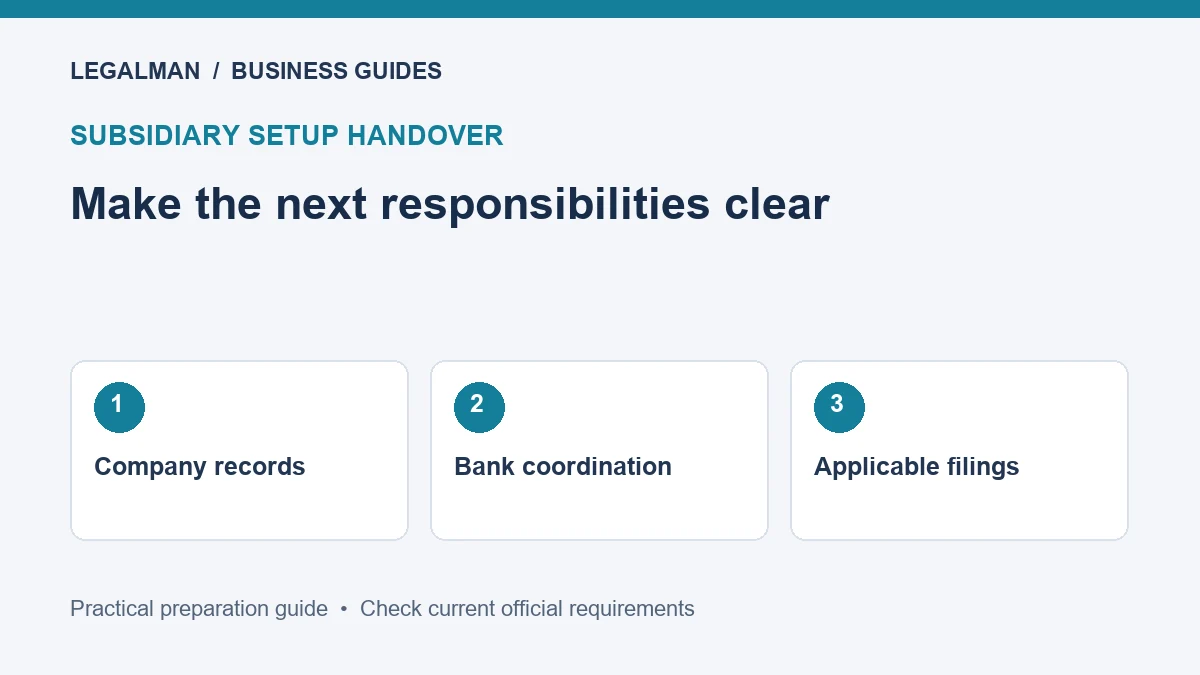
When setting up a subsidiary company in India, plan the handover before incorporation work ends. Directors, the overseas parent, accountants and the bank may each hold part of the information needed for the next stage. A clear handover makes responsibilities visible without assuming that one certificate completes every obligation.
Create a controlled company record
Agree where incorporation records, approvals and core entity information will be retained. Give each document a clear name and preserve signed or issued originals where relevant.
Identify who maintains the current version of ownership and director information. When the parent and Indian teams use different trackers, reconcile them before treating either as the authoritative record.
Separate workstreams and owners
List company records, banking, accounting, tax-registration review and foreign-investment reporting as separate workstreams. Check applicability for the actual business rather than adding a generic list of registrations to every company.
Allocate a named owner and a reviewer to each task. A service provider’s scope should state which work is included and which facts or actions must be supplied by the company or parent.
Coordinate investment information with the bank
Keep the funding plan, relevant transaction records and contact with the authorised dealer bank organised. Confirm the current reporting route and applicable requirements before acting on a transaction.
The RBI FIRMS portal directs applicants to their AD bank as the first point of contact for queries. A bank discussion is useful for coordination, but it does not replace a review of the obligations applicable to the investment.
Build a date-based compliance calendar
Record actual incorporation and transaction dates, then obtain the applicable filing and action requirements. Do not copy deadline dates from another company or assume a reminder service makes a filing complete.
At handover, ask for a list showing completed items, evidence, open dependencies and the person responsible for the next action. Preserve the difference between preparation, submission and acceptance in that list.
Ask for a handover that shows the evidence
A task marked “done” is easier to assess when the handover links to the issued document, submitted form or acknowledgement. Keep “prepared,” “submitted” and “accepted” as different statuses. This also helps a new accountant or company contact understand what is actually complete without reconstructing the whole setup exercise.
Frequently asked questions
Is an incorporation certificate a complete compliance clearance?
No. Review the obligations and registrations relevant to the actual company and transactions separately.
Who should handle foreign-investment reporting questions?
Coordinate with the responsible adviser and the AD bank. The appropriate requirements depend on the transaction.
Should every company use the same compliance calendar?
No. Build it around the entity’s facts, applicable rules and actual event dates.
Plan your next step
For a review of your own records and the assistance needed, explore our foreign subsidiary setup support. Share the relevant records so that missing information can be identified before work begins.
Official reference: Government guidance and current application information. This article is a practical preparation guide, not an exhaustive statutory checklist. Requirements depend on the project, transaction and rules applicable when action is taken.