
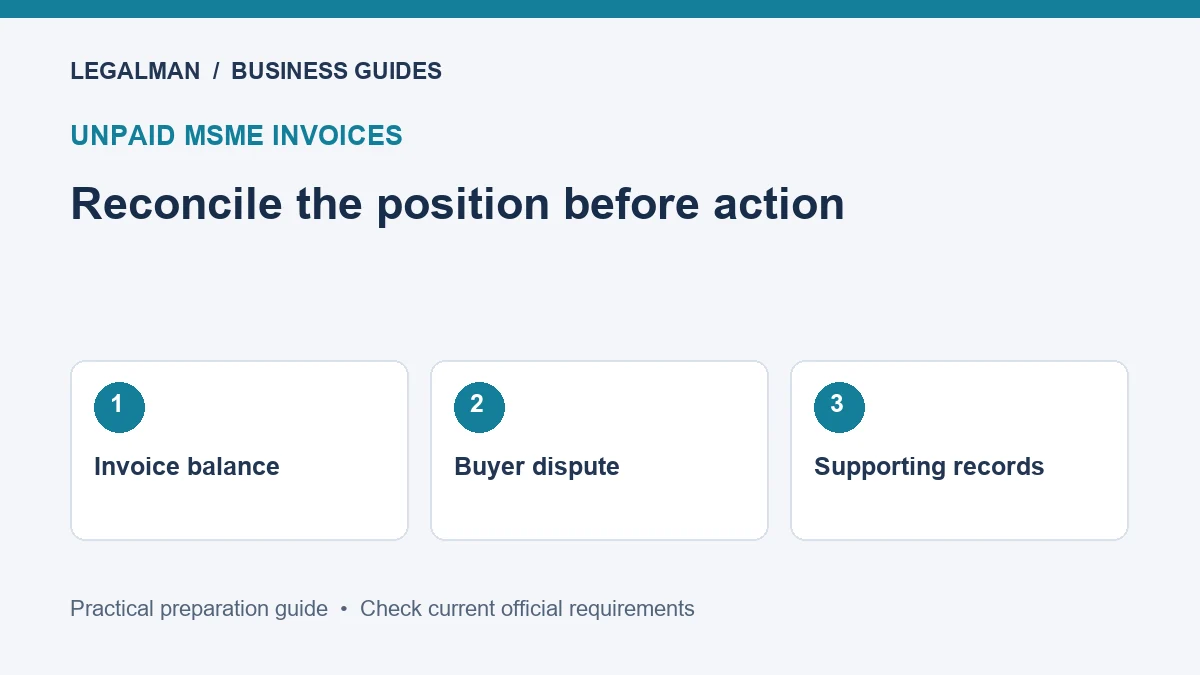
Delayed payment recovery starts with understanding the unpaid balance and the reason it remains unpaid. A buyer may acknowledge an invoice, dispute performance, claim a deduction or simply fail to respond. Keep these situations separate when preparing a recovery review.
Create an invoice-by-invoice position
List each invoice, original value, payments received and remaining balance. Add a column for the buyer’s stated position and another for the evidence supporting your own position.
Use source records for credit notes and adjustments. If the parties’ ledgers differ, show both figures and explain the unresolved difference rather than quietly treating one as agreed.
Separate the issues
Group the questions into identity, order terms, performance, delivery or acceptance, deductions and payment. A chronology can then connect each issue with the relevant document.
Record where the buyer has not responded. Silence should not be rewritten as a clear admission without a case-specific basis. Preserve the original correspondence and its context.
Prepare a focused commercial communication
Before sending a reminder or demand, check the recipient’s identity, the amount being described and the records supporting it. State clearly which invoices and adjustments are involved.
Avoid making claims about guaranteed legal outcomes or threatening steps that have not been assessed. Where a formal notice or disputed legal position is involved, obtain advice on the wording and route.
Review the remedy before escalation
The Ministry’s MSE delayed-payment framework has eligibility conditions. Check the supplier, transaction, timing and forum with a competent adviser before assuming that a particular process is available.
Evidence preparation and commercial reconciliation can support a review, but they do not decide jurisdiction, limitation or the merits. Keep those legal questions visible instead of labelling the file ready merely because the PDFs have been uploaded.
Keep the arithmetic and dispute separate
Imagine that the supplier records ₹80,000 outstanding but the buyer claims a ₹10,000 deduction for incomplete work. The reconciliation should show the ₹80,000 ledger balance and describe the disputed ₹10,000 separately. That presentation explains the disagreement; it does not decide whether the deduction is justified.
Frequently asked questions
Should disputed deductions be ignored?
No. Identify them separately and retain the records explaining both parties’ positions.
Can a reconciliation spreadsheet replace the original invoices?
No. It is a summary that should link to the underlying records.
Does the term MSME guarantee access to every recovery remedy?
No. Eligibility and the appropriate route must be checked for the actual case.
Plan your next step
For a review of your own records and the assistance needed, explore our MSME payment recovery support. Share the relevant records so that missing information can be identified before work begins.
Official reference: Government guidance and current application information. This article is a practical preparation guide, not an exhaustive statutory checklist. Requirements depend on the project, transaction and rules applicable when action is taken.